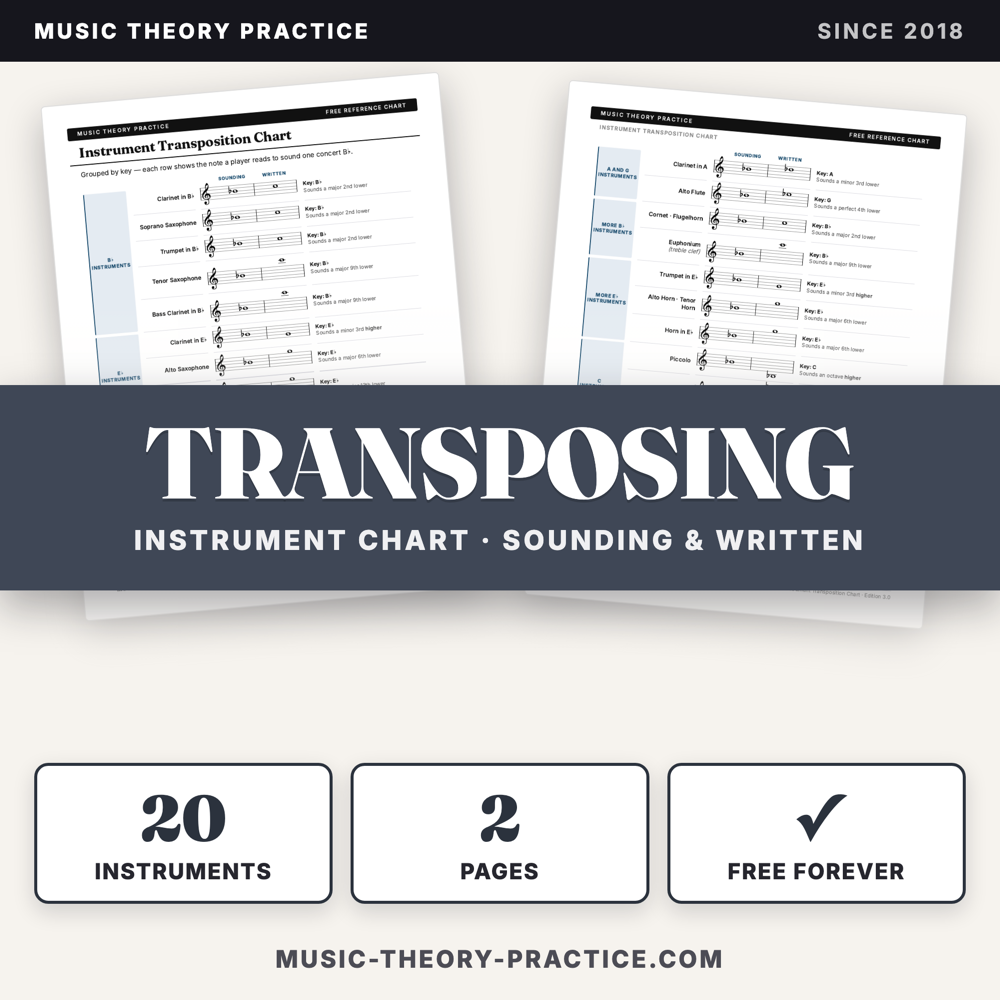
Instrument Transposition Chart
Every transposing instrument, grouped by key, with the note each player reads engraved beside the pitch it sounds.
Prefer teacherspayteachers.com? Download it there →
- Print as many copies as you like
- Free — no purchase, no catch
- Instant download
Free forever · yours to keep · works on any printer.
About this set
A reference chart you can read straight down. Every instrument sits on its own row with a real engraved staff: the concert pitch on the left of the barline, the note that player has to read on the right. Because every row is drawn to the same scale, the sounding notes line up in one column while the written notes visibly disagree — which is the whole idea of transposition in one picture. Instruments are grouped by key, so the pattern reads as a rule rather than a list. Page two covers the octave transposers and the less common B♭ and E♭ horns.
What's included
- Twenty transposing instruments, grouped by key
- Every row engraved on a staff — sounding pitch beside written pitch
- Key and exact interval spelled out for each instrument
- Page 2: octave transposers, plus cornet, euphonium, alto horn and E♭ trumpet
- Why C instruments like piccolo, guitar and double bass still transpose
- 2 printable pages, US Letter — free for personal and classroom use
Who it's for
Ideal for band, orchestra and arranging classrooms — students, teachers, and anyone practicing away from a screen.
Prefer to practice online? Try the free transposition flashcards →