How to Find Notes on the Piano
How to name every white and black key on the piano, starting from the pattern of black keys. Every keyboard on this page plays when you press a key.
- Black keysThey come in groups of two and three. Find them first.
- C and FC is just left of every group of two black keys. F is just left of every group of three.
- White keysSeven letters, A B C D E F G, then the pattern starts over.
- Two namesEach black key is the sharp of the key to its left and the flat of the key to its right: C♯ is the same key as D♭.
In this guideBlack key groups · The musical alphabet · C and F · Middle C · Sharps and flats · Half steps · Check yourself
Learning Objectives
- I can find the groups of two and three black keys
- I can name every white key, using C and F as landmarks
- I can find middle C on a full-size piano
- I can give both names of any black key
- I can explain why E and F, and B and C, have no black key between them
Try It: The Keyboard
Press any key to hear it and see its name. Show names labels every key at once, sharps and flats included.
The rest of the page shows how to find each of these keys on a real piano, where nothing is labeled. It all starts with the black keys.
1 The Black Keys Come in Twos and Threes
Look at the black keys before anything else. They are not evenly spaced. They come in a group of two, then a group of three, then two again, then three, all the way up the keyboard.
That pattern is how pianists find their way around. A piano with 88 keys has the same pattern from one end to the other, and so does a small keyboard with 25 keys. Once you can spot the twos and threes, every white key has a place you can describe: next to the group of two, or between two keys of the group of three.
Try it on the keyboard: point to every group of two, then every group of three, without counting the white keys.
2 The Musical Alphabet
The white keys are named with the first seven letters of the alphabet: A B C D E F G. After G the letters start over at A. There is no H.
Moving to the right goes up: each key sounds higher than the one before it, and the letters go forward. Moving to the left goes down, and the letters go backward: G F E D C B A, then G again.
From one key to the next key with the same letter is an octave. The two notes sound alike, one higher than the other, which is why they share a name.
3 Finding C and F
Two white keys are easy to find from the black keys, and they make good landmarks:
- C is the white key just left of each group of two black keys.
- F is the white key just left of each group of three black keys.
Every other white key is a step or two from one of these. Around the group of two you have C D E: D sits between the two black keys, and E is just right of them. Around the group of three you have F G A B: G and A sit between the black keys, and B is just right of them.
To find any white key, go to the nearest C or F and say the letters as you move up.
4 Where Is Middle C?
A full-size piano has 88 keys: 52 white and 36 black. The lowest key is an A and the highest is a C, and there are eight Cs in all.
Middle C is the fourth C from the left. It is near the middle of the keyboard, a little to the left of center: it is the 40th key from the bottom. On a smaller keyboard, look for the C closest to the middle.
Middle C is also called C4. In this system, called scientific pitch notation, each octave gets a number, and the number goes up by one at every C. The C below middle C is C3, the D just above middle C is D4, and the lowest key on the piano is A0.
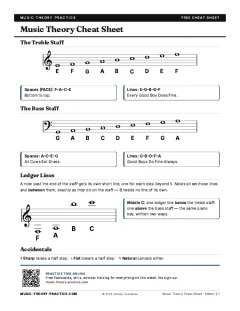
On the staff. Middle C is written on one ledger line below the treble staff, or one ledger line above the bass staff. It is the note where the two staves of piano music meet. The ledger lines guide shows both.
5 Black Keys: Sharps and Flats
The black keys don't have letters of their own. Each one is named from a white key beside it:
- A sharp (♯) raises a note to the next key on the right. C♯ is the black key just right of C.
- A flat (♭) lowers a note to the next key on the left. D♭ is the black key just left of D.
Those are the same key. Every black key has two names, one sharp and one flat: C♯ and D♭, D♯ and E♭, F♯ and G♭, G♯ and A♭, A♯ and B♭. Two names for the same key are called enharmonic spellings.
Which name you use depends on the music. A piece in the key of F major uses B♭, and a piece in G major uses F♯. When you are only naming keys, either name is correct.
6 E and F, B and C: No Black Key Between
A half step is the distance from any key to the very next key, black or white, with nothing in between. C to C♯ is a half step, and so is C♯ to D.
Most pairs of white keys have a black key between them, so they are two half steps apart, a whole step. Two pairs don't: E and F, and B and C. They are already a half step apart, so there is no pitch between them for a black key to play. That is where the gaps in the black keys come from.
It also means a sharp or flat can land on a white key. E♯ is the key F, and C♭ is the key B. You will see those names in keys with many sharps or flats; F♯ major has an E♯, for example.
7 Check Yourself: Name the Key
A key lights up on the keyboard. Name it with the buttons, which are laid out like the keys: black-key names on top, white keys below.
Don't count up from the bottom of the keyboard. Find the group of black keys nearest the lit key first, then go from C or F. For a black key, either of its names is right.
When five in a row feel easy, the Piano Keys Practice drill keeps going as long as you like. It can also ask the other way around: it names a key and you press it.
8 Common Mistakes
Counting from the bottom. Counting white keys from the left end of the keyboard is slow and easy to get wrong. Use the nearest group of black keys instead.
Mixing up the two groups. C sits by the group of two and F by the group of three. If you keep calling F “C,” or C “F,” check which group you were looking at.
Looking for a black key between E and F. There isn't one, and there isn't one between B and C. The next key up from E is F.
Keep going
Frequently asked questions
How many keys are on a piano?
A standard piano has 88 keys: 52 white keys and 36 black keys. The lowest key is A0 and the highest is C8.
Where is middle C on the piano?
On an 88-key piano, middle C is the fourth C from the left and the 40th key from the bottom, a little left of the center of the keyboard. Like every C, it is the white key just left of a group of two black keys. It is called C4.
How do you remember the notes on the piano?
Use the black keys. They come in groups of two and three. C is the white key just left of every group of two, and F is the white key just left of every group of three. From C or F, count up through the musical alphabet to find the rest.
What are the black keys on the piano called?
Each black key has two names. It is the sharp of the white key to its left and the flat of the white key to its right, so the black key between C and D is both C sharp and D flat.
Why is there no black key between E and F?
E and F are already a half step apart, the smallest distance between two keys on the piano. B and C are a half step apart too. There is no pitch between them for a black key to play.
What are the letter names of the piano keys?
The white keys use seven letters, A B C D E F G, and repeat them all the way up the keyboard. The black keys take their names from the white keys beside them, with a sharp or a flat.
Related: Piano Keys Practice · how to read treble clef notes · how to read bass clef notes · how to read ledger lines · how to memorize major scales.